Tips and Information about making jewelry


With this blog, I hope to share my knowledge, successes, trials and errors, student's work, tips, and information about making jewelry.

Wednesday, May 28, 2014

Lights, Camera, Action! Behind the Scenes - Shooting Quality Photos


  I was recently asked to submit 15 photos of artwork to a magazine for a local art tour of professional artists. We have over 25 artists. It shouldn’t be hard to find 15 quality photos, right?
Wrong! Some were out of focus, others showed junk in the background, or had their item laying in bright red cloth, and lastly the color was off. I find this happens more often than not.

So, in this blog series, I’m sharing some simple tips on creating quality photos of artwork (jewelry in this case).

Holding the Camera
The camera must have a camera stand. This removes most of the chances of blurry photos. They don’t cost that much, less than $36.  Most cameras have a screw hole in the bottom that allows for mounting on a stand. I read somewhere there is now a camera stand for iPhones too.

The Background
When setting up your shot, look in the background. Put jewelry on a neutral background. Bright colors, like red, blue, or yellow take away the focus of the main object. Additionally, colorful backgrounds reflect their color onto jewelry. Look at the reflection on the jewelry to see what color is showing, especially if it’s silver jewelry. A bright color makes the silver appear to be that color. For my background I use a white cutting board or a gray card.

Set the White Balance
Have you ever taken a photo that turns out blue or really yellow, but when you look at the setup it looks fine to your eye? That’s because the digital camera is picking up light different than your eye. All cameras have a setting that allows you to set the white balance. This setting is what changes that same shot to the corrected color. Different lights cause different colors. For example, fluorescent lighting adds a bluish cast to photos whereas tungsten (incandescent/bulbs) lights add a yellowish tinge to photos. Check your camera’s user manual to find the white balance setting menu. The easiest setting to use is "Auto". The camera makes a best guess of balancing on a shot by shot basis on the auto setting.

Lights and Lamps
I used to go outside on a cloudy day or find a shady spot to photograph my silver jewelry. Shade offers natural lighting, but the problem is the reflecting light. If I have a wall nearby the color reflects off my jewelry. A quick, easy, and cheap way to obtain natural lighting (I found out from Doug Baldwin) is to use CFL Daylight bulbs in a desk lamp. They can be bought at most hardware and discount stores. Use a desk lamp with the movable neck. This allows you to move it closer or further from your jewelry.


Softening the Light
A bare light bulb near shiny jewelry reflects a bright shine! The light must be diffused or scattered. An easy way to do this is to place tracing paper in front of the bulb (another tip from Doug Baldwin). If using the CFL bulbs they don’t get as hot as other bulbs, so it’s not as much as a fire hazard to do this. I lightly tape the tracing paper over the end of the lampshade. Of course, don’t leave the lights covered with paper for a very long time. It can cause a fire!


This is a good start on setting up your shots. Next time I’ll cover the secrets of making the jewelry behave and sit correctly!

Sunday, March 30, 2014

Bench Tips: Filing Wire, and Cutting Wire Lengths


Many times as we work with metal hammering, texturing, or bending it, it becomes work-hardened. Some metal is sold in this hardened state. Too much work-hardening can make the metal crack! Texturing the metal can not only make it hardened but miss-shaped. It must be annealed or softened making it bendable.


Wire cut with flush cutters still have slightly pointed ends. Easily file them flat without bending the wire by placing the wire inside flat-nose pliers with just the tip hanging out the other side. This holds the wire while filing it flat.

Additionally, place the wire into the very point of the “V” shape in the bench pin with the end pointing upward. This holds the wire so it can be filed flat.


If you’d like to saw the wire instead of cutting it with pliers, make a channel across the top of the bench pin using a wood saw.

Now place the wire into the channel hanging it out the distance needed and saw it off against the side of the bench pin. Additionally, if cutting the same length wire (less than the width of the bench pin), mark the distance from the edge of the bench pin to the length of the wire on top of the bench pin. After cutting the wire, slide the next length out to the correct distance and then cut it.

Sunday, March 23, 2014

Bench Tips Straightening Wire & Picking up Small Stones


I’d like to pass on some tips I use when working with metal or setting stones. Have you ever had a small piece of wire you wanted to use but it was all bent out of shape? Well here is a tip on how to make it straight again!
Bend it as straight as you can using flat-nose pliers. Place the wire on a smooth anvil or steel block with another anvil or smooth steel block over the wire. Slide the top block back and forth across the bottom one keeping the wire between the blocks. The wire rolls along straightening out as it rolls! Also, this is a great way to work-harden the wire!


Have you had a hard time picking up tiny stones while placing them into a setting? Roll some bee’s wax between your fingers into a point. Now use the point to pick up the small stone. To remove the stone from the wax, place it into the setting and roll the tip of the wax away from the stone. To clean the wax off the stone wipe it with a towel after setting it. If you plan to fire the stone in place, the wax burns off cleanly in the kiln.


Found on the model isle
Additionally, there is a product I found at Hobby Lobby called Pic- n- Stic. It works the same way for holding stones.

Holds without leaving residue

Friday, March 7, 2014

Fixing a Common Problem with Butane Torches

Problem Torches

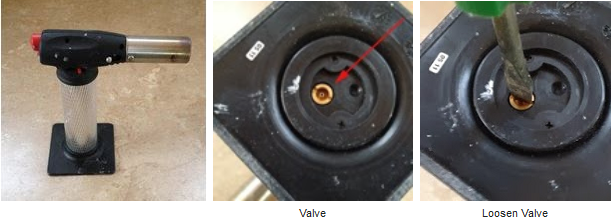
Have you ever had a problem with the small butane torch acting like its empty even though you just filled it? That's because over time compressed air from the butane can fills the fuel container. The torch is full of air.

Easily remove this excess air by unscrewing the valve on the bottom of the torch allowing the compressed air to escape. Then re-tighten the screw and re-fill the torch with butane.


Tell me about some problems you are having and I will post the answers in a blog!
Janet Alexander

Tuesday, February 11, 2014

Tips From the Bench - Ring Gauges and Mandrels


Ring gauges and ring mandrels are used in concert to make rings. Ring gauges are used to measure the size of a person's finger and ring mandrels are used for manufacturing rings to the required size. In metal clay, we wrap the clay around a paper covered mandrel at the required size. In metal smithing, we wrap the metal around the mandrel at the correct size.

The typical  ring mandrel is a tapered and made of steel with the sizes engraved on it. In metal clay we also have the stepped mandrels sized in two sizes, either whole sizes or half sizes. 


Did you know that not all ring gauges and ring mandrels match? When you first purchase your ring gauges and a ring mandrel, check to see if they match and you might be surprised! Check several sizes, because some might be correct while others are not.


Size 7 is on 6 3/4" line

8 Fits correctly

This size 7 narrow ring gauge should slide down to the size 7 on the tapered ring mandrel, so the tapered mandrel is incorrect for this size.

The photo to the right shows that the size 8 wide band fits correctly on this size 8 short step mandrel.


Size 9 doesn't fit
But the size 9 wide ring gauge doesn't even fit onto the size 9 mandrel and neither does the narrow size 9 ring gauge.

(Interestingly the size 8 is on the same mandrel as the size 9!)


What's important to know is what to do if they don't match.

Since I measured the finger with the ring gauge, its important that I make the ring the size of the ring gauge. With the tapered mandrel, I slip the ring gauge onto the mandrel and draw lines on both sides of the ring gauge using a permanent marker. Now I work the ring around the mandrel between those lines.


With the miss-matched short stepped mandrel I wrap wax paper around either the size 8 or 8 1/2 mandrels until the size 9 ring gauge fits correctly.


I hope this helps those of you who have had problems with rings not fitting the finger.

Saturday, January 18, 2014

Saving $$ by Making your Own Inexpensive Sanding Discs


This tip is for those of you who like to use a sanding disc with your rotary tool. I don’t know about you, but sanding discs just don’t last long and can become very costly. Here is a way to make your own.
You will need:
  • Plastic milk jug or a 1 liter plastic jug 
  • small punch or awl 
  • rubber cement or spray adhesive 
  • sandpaper (you choose the grit) 
  • scissors mandrel shank 
  • small screw driver 
  • circle template
  •  fine tipped marker

1.  Cut a flat section of plastic out of the milk jug.
2.  Trace the cut plastic shape onto the back of your sandpaper.
3.  Cut out the sandpaper shape.
4.  Apply rubber cement or spray adhesive to the back of the sandpaper and to the plastic piece.
5.  Allow both to dry.
6.  Attach the sandpaper to the plastic by pressing them both together.


7.   Trace 1” circles onto the plastic try to get them close as possible.
8.  Cut circles out with scissors.


9.  Punch a small hole into the center of each circle.

10. Attach the sanding disc to the mandrel by pressing the mandrel’s screw through the disc’s center hole.

A sanding disc quickly sands flat edges, and is bendable allowing you to sand tight areas. 


Lets hear about your ideas on making a tool to save money! Post your comments here.

Friday, January 10, 2014

Surprising Ideas You Can Come up With in A Pinch!

Janet Alexander
Fine silver bead with granulation
Have you ever wanted to dome something in metal clay only to find you don’t have the correct size or slope? I've had that  happen to me. So, I looked around my studio to find an object I could use that had the correct size and dome. I wanted a small round high dome so I could make this bead.


I decided to make a mold of the ultra sonic lid’s handle. Here is what you can make on the spur of the moment with stuff sitting around your shop.  I pulled out these items.


Top to an ultra sonic cleaner   2 ea. Gatorade caps two part silicone mold compound two part epoxy a scale weight popsicle stick tooth picks colorant


Mix the two part silicone mold compound in equal parts until they become one color
Press into the cap. This gives the mold a flat surface at its opening.


Press the object into mold compound. In my case the lid’s handle. Weight it down so that as the compound sets it doesn’t push the object out.
Allow it to set (per manufactures recommendations).


Then make a form out of resin in the mold. I added a paper lip around the cap so I can pour extra resin making a footing for my form.
Mix equal parts of two part epoxy, enough to fill the mold. I added colorant to make it easy to spot the form on my cluttered workbench and just to make it fun.
Allow the epoxy to set, per the manufactures recommendation.


Remove dried epoxy and enjoy your own custom form!
Remember to lubricate the form before laying metal clay over it!  Do not place the form on a hot plate to dry the clay, it may burn!